
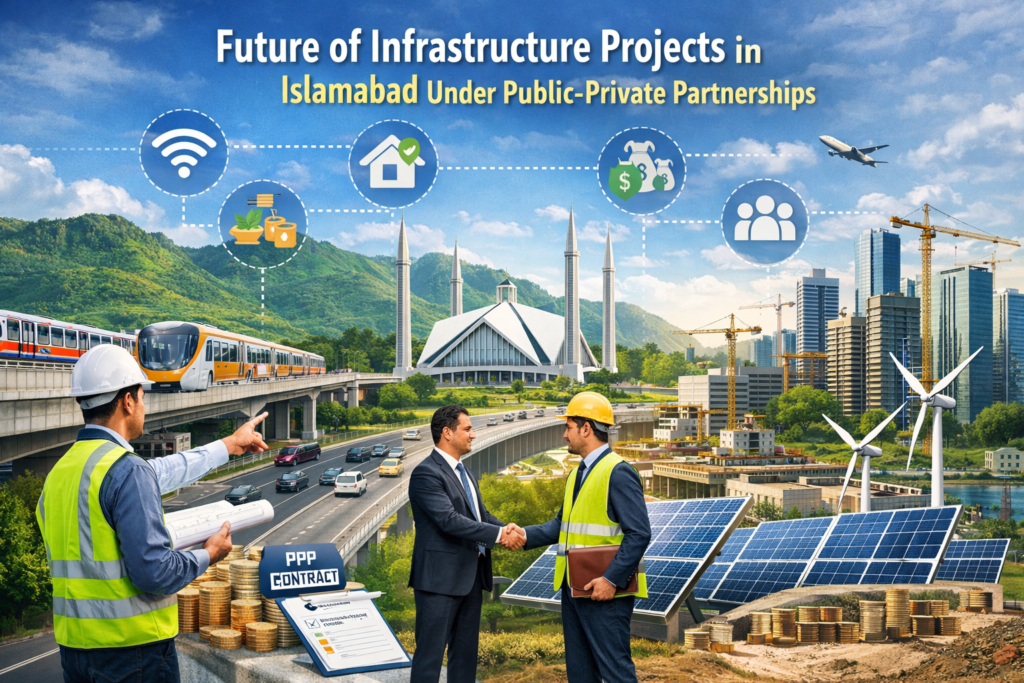
Islamabad, the capital of Pakistan, has long symbolized planned urban development, modern architecture, and national significance. With rapid population growth, evolving urban demands, and rising expectations for high-quality infrastructure, the city stands at the threshold of a transformative phase. One of the most promising strategies to accelerate this transformation is the Public-Private Partnership (PPP) model.
In this blog, we explore how PPPs are shaping Islamabad’s infrastructure future — from roads and transit systems to smart city initiatives and sustainable utilities — and why this collaborative model is becoming increasingly important.
What Are Public-Private Partnerships (PPPs)?
Public-Private Partnerships bring together the innovation, efficiency, and capital strength of the private sector with the regulatory authority and long-term vision of the public sector.
Under PPP models:
- Private companies invest capital and technical expertise.
- Government entities provide policy support and regulatory oversight.
- Risks and rewards are shared between stakeholders.
For Islamabad, this means faster project delivery, improved service standards, and stronger economic resilience.
Why Islamabad Needs PPP-Led Infrastructure Development
Islamabad’s importance continues to grow — from diplomatic missions and corporate hubs to expanding residential zones and tourism centers. However, urban congestion, pressure on utilities, and limited public financing demand new infrastructure strategies.
Here’s why PPPs are ideal for Islamabad:
1. Accelerated Development
Traditional public funding can delay large-scale infrastructure projects due to budget limitations. PPPs invite private investment, enabling faster completion of highways, bridges, transit systems, and commercial zones.
2. Innovation and Efficiency
Private sector firms bring global engineering practices, digital project management systems, and performance-driven approaches. This ensures higher efficiency and cost optimization.
3. Shared Financial Risk
Construction delays, cost overruns, and operational inefficiencies can be shared between public and private partners, reducing financial pressure on government budgets.
4. High-Quality Infrastructure Outcomes
PPP agreements typically include performance benchmarks, ensuring long-term quality in design, construction, and maintenance.
Key Infrastructure Areas Shaping Islamabad’s Future
1. Transportation and Mobility
Traffic congestion is increasingly affecting Islamabad and its twin city Rawalpindi. PPP-backed projects such as Bus Rapid Transit (BRT) expansions, potential light rail systems, and improved road networks can significantly enhance urban connectivity.
Efficient transport systems improve daily commute times, reduce fuel consumption, and strengthen economic productivity.
2. Smart City and Digital Infrastructure
Islamabad has strong potential to become a regional smart city leader. PPP investments can help build:
- Integrated traffic control systems
- IoT-enabled municipal services
- Smart utility management platforms
- Digital payment systems
- Advanced surveillance and emergency response networks
Collaborations with engineering-driven firms like Gemcon Engineering Company can ensure modern technologies are embedded in long-term infrastructure planning.
3. Utilities and Sustainable Energy
Reliable water, electricity, and waste management are foundational to urban growth. PPPs can attract funding for:
- Solar and renewable energy projects
- Waste-to-energy facilities
- Water treatment and recycling plants
- Smart grid infrastructure
Embedding sustainability standards into PPP contracts helps align projects with environmental and climate objectives.
4. Affordable Housing Initiatives
Islamabad’s expanding population has increased demand for affordable housing. PPP frameworks allow government and developers to collaborate on delivering mixed-income housing communities at scale.
This approach supports inclusive urban growth while easing pressure on informal settlements.
5. Tourism, Culture & Urban Spaces
Islamabad is home to iconic landmarks such as Faisal Mosque and the scenic Margalla Hills. PPP investments in:
- Cultural centers
- Eco-tourism facilities
- Recreational parks
- Convention and exhibition spaces
can position the capital as a vibrant destination for domestic and international visitors.
Successful PPP Examples in Islamabad
Islamabad has already experienced infrastructure progress through PPP-supported road networks and bypass projects connecting urban and suburban regions.
These examples demonstrate that when the public and private sectors align around shared goals and transparent governance, tangible results follow. The next step is expanding PPP frameworks across additional sectors with structured long-term planning.
Governance & Regulatory Framework Needed for PPP Success
For PPP initiatives to thrive in Islamabad, strong governance mechanisms are essential.
1. Clear Legal Frameworks
Legislation must define contract terms, revenue-sharing mechanisms, ownership structures, and dispute resolution processes.
2. Transparent Bidding and Evaluation
Competitive and transparent procurement builds investor confidence and ensures merit-based project allocation.
3. Long-Term Public Sector Commitment
Authorities such as the Capital Development Authority (CDA) must ensure ongoing monitoring, evaluation, and administrative support.
4. Comprehensive Risk Management
Detailed risk assessments and mitigation strategies protect both public interests and private investments.
Challenges and How to Overcome Them
While PPPs offer advantages, they also face challenges:
Funding Barriers
Limited access to low-cost financing may restrict private sector participation. Solutions include blended finance models, multilateral development funding, and sovereign guarantees.
Public Perception and Resistance
Citizens may misunderstand PPP models, fearing privatization. Public awareness campaigns and transparent communication can build trust.
Coordination Complexities
Large infrastructure projects require collaboration between ministries, private developers, engineers, and local authorities. Structured governance committees and centralized oversight units can improve coordination.
Opportunities Ahead
Islamabad has the opportunity to become a regional leader in PPP-driven infrastructure innovation. Key growth avenues include:
- Dedicated PPP regulatory units
- International investor partnerships
- Sustainable infrastructure financing mechanisms
- Capacity building for public officials and engineers
With strategic planning and institutional support, the city can attract high-quality investments that drive long-term prosperity.
How Engineering Companies Will Lead the Way
Engineering firms are not merely contractors in PPP projects — they are strategic contributors to project design, execution, and sustainability.
Companies with strong technical expertise, local regulatory understanding, and integrated project delivery models will be central to Islamabad’s transformation.
Forward-thinking firms like Gemcon Engineering Company can help ensure that PPP infrastructure projects prioritize quality, resilience, innovation, and long-term operational performance.
Conclusion: A Collaborative Blueprint for Islamabad’s Future
The future of infrastructure in Islamabad lies at the intersection of public vision and private sector capability. Public-Private Partnerships provide a powerful mechanism to deliver projects faster, more efficiently, and with sustainable impact.
By adopting transparent governance, inclusive planning, and strong engineering collaboration, Islamabad can:
- Strengthen economic growth
- Enhance living standards
- Develop future-ready infrastructure
- Set a benchmark for other cities in Pakistan
As PPP-driven initiatives expand, Islamabad’s transformation will reflect not only physical development but also a progressive model of collaborative urban innovation.