
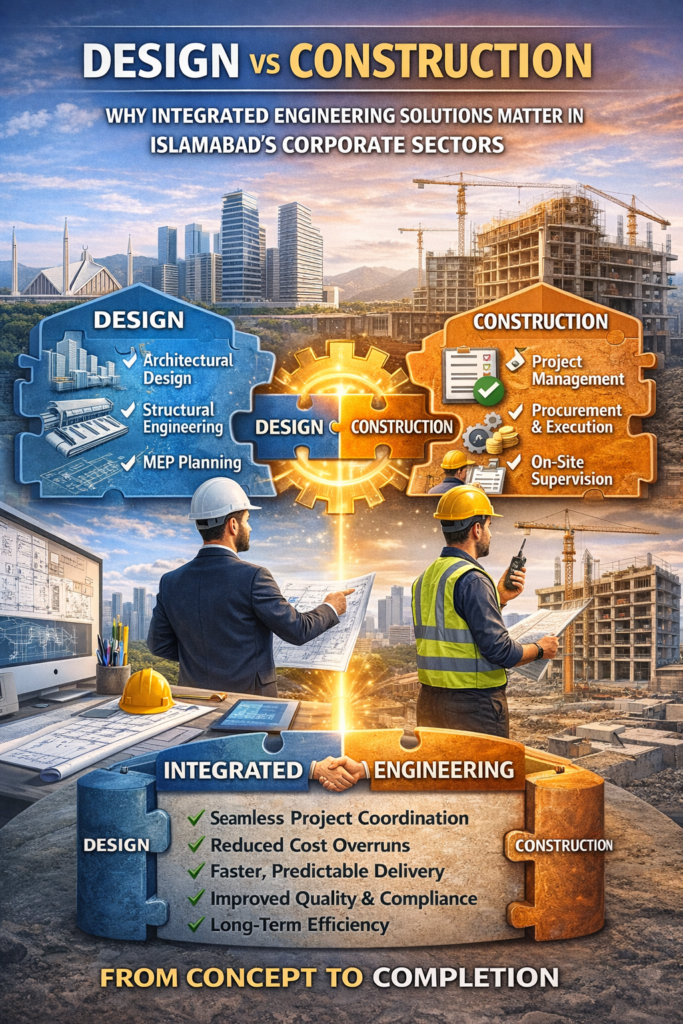
Islamabad’s corporate landscape is evolving rapidly. From high-rise office towers in Blue Area to corporate campuses, IT parks, and commercial plazas, the capital city is witnessing a surge in modern infrastructure development. As competition intensifies and project expectations rise, businesses can no longer afford inefficiencies between design and construction phases.
Traditionally, design and construction were handled as separate processes. Architects and engineers prepared designs, and contractors later executed them. While this approach worked in the past, it often led to communication gaps, cost overruns, and delays.
Today, integrated engineering solutions are transforming Islamabad’s corporate construction sector. Companies offering end-to-end services, such as Gemcon Engineering, are helping organizations streamline their projects from concept to completion. You can explore their professional construction solutions here:
https://gemconengineering.com/our-constructions-services/
Let’s explore why integrated engineering solutions matter more than ever in Islamabad’s corporate environment.
Understanding the Gap Between Design and Construction
In traditional project models:
- Designers focus on aesthetics and structural planning.
- Contractors focus on execution and cost control.
- Communication often flows through multiple intermediaries.
This separation can result in:
- Design plans that are difficult to execute.
- Budget miscalculations.
- Delays due to redesigns.
- Structural or compliance issues discovered during construction.
In Islamabad’s regulated and competitive corporate sector, such inefficiencies can significantly impact project timelines and investment returns.
What Are Integrated Engineering Solutions?
Integrated engineering solutions combine:
- Architectural design
- Structural engineering
- MEP (Mechanical, Electrical & Plumbing) planning
- Project management
- Construction execution
Under one coordinated system or organization.
Instead of isolated teams working independently, integrated solutions ensure all stakeholders collaborate from the project’s early conceptual stage to final delivery.
This unified approach reduces misunderstandings, aligns objectives, and improves overall project performance.
Why Islamabad’s Corporate Sector Needs Integration
Islamabad’s corporate sector demands:
- High-quality modern infrastructure
- Compliance with CDA regulations
- Efficient land utilization
- Energy-efficient building designs
- Fast project turnaround
Corporate clients—especially multinational companies, banks, tech firms, and commercial developers—require predictable budgets and timelines.
Integrated engineering ensures these demands are met without compromise.
1. Improved Project Coordination
When design and construction teams work under a unified structure:
- Design feasibility is assessed early.
- Construction constraints are considered during planning.
- Material availability and cost are factored into design decisions.
This eliminates common issues such as unrealistic structural designs or materials that exceed the allocated budget.
In Islamabad’s fast-moving corporate zones, better coordination translates directly into faster project completion.
2. Reduced Cost Overruns
One of the biggest challenges in corporate construction is budget escalation.
Separate design and construction phases often lead to:
- Frequent design revisions.
- Contractor change orders.
- Material substitutions.
- Miscommunication-related expenses.
Integrated engineering solutions reduce these risks by aligning cost estimation with design decisions from the start.
Accurate BOQs, synchronized procurement planning, and continuous financial monitoring ensure corporate clients avoid unexpected financial strain.
3. Faster Project Delivery
Time is money in Islamabad’s corporate environment.
Delays can result in:
- Lost rental income.
- Delayed business operations.
- Increased financing costs.
- Reduced investor confidence.
Integrated teams streamline approval processes, construction scheduling, and milestone tracking.
Because engineers, architects, and construction managers collaborate continuously, issues are resolved proactively instead of reactively.
This significantly shortens the project lifecycle.
4. Enhanced Regulatory Compliance
Islamabad operates under strict development regulations enforced by CDA and other authorities.
Corporate buildings must comply with:
- Structural safety codes
- Seismic design requirements
- Fire safety standards
- Environmental regulations
- Zoning laws
In an integrated model, compliance experts are involved from day one. This prevents costly redesigns or approval rejections later in the process.
For corporate developers, this means smoother approvals and reduced legal risk.
5. Better Risk Management
Construction projects inherently carry risks:
- Technical risks
- Financial risks
- Environmental risks
- Contractual risks
Integrated engineering firms conduct comprehensive risk assessments across all project phases.
Because design and construction teams communicate continuously, potential risks are identified early—whether it’s soil instability, material price volatility, or design conflicts.
This proactive risk mitigation protects both public and private investments.
6. Superior Quality Control
Corporate clients demand premium construction standards. Whether it’s a corporate headquarters or a commercial tower, the building must reflect professionalism, durability, and long-term reliability.
Integrated engineering enhances quality by:
- Conducting coordinated structural analysis.
- Ensuring MEP systems integrate seamlessly with architecture.
- Performing regular on-site supervision.
- Using digital monitoring tools.
Quality control becomes part of the system—not an afterthought.
7. Seamless Communication
One of the biggest hidden costs in construction is miscommunication.
When architects, engineers, contractors, and consultants operate separately, information gaps occur. These gaps can cause:
- Design clashes
- Material delays
- Scheduling conflicts
Integrated engineering eliminates these communication barriers.
A single project management framework ensures transparency, accountability, and smooth information flow.
For Islamabad’s corporate sector, this professionalism enhances stakeholder confidence.
8. Adoption of Modern Technology
Integrated engineering solutions often incorporate:
- Building Information Modeling (BIM)
- 3D visualization
- Digital project tracking systems
- Real-time cost monitoring
These technologies detect design clashes before construction begins, predict structural performance, and optimize resource allocation.
Corporate investors benefit from data-driven decisions and improved project transparency.
9. Long-Term Sustainability and Efficiency
Modern corporate buildings in Islamabad aim to be:
- Energy-efficient
- Environmentally responsible
- Cost-effective to operate
Integrated engineering allows sustainability to be built into the design from the beginning.
Instead of retrofitting energy solutions later, integrated teams design HVAC systems, insulation, lighting, and water management strategies cohesively.
This reduces long-term operational costs and enhances building value.
10. Stronger Accountability
When design and construction are handled separately, responsibility for errors often becomes disputed.
Integrated engineering solutions provide a single accountable entity responsible for:
- Design integrity
- Construction quality
- Budget adherence
- Timeline management
This accountability simplifies dispute resolution and builds trust with corporate clients.
How Integrated Engineering Strengthens Corporate Growth
Islamabad’s corporate expansion depends on reliable infrastructure.
Integrated engineering:
- Enhances investor confidence
- Reduces project uncertainty
- Improves financial predictability
- Strengthens brand reputation
- Ensures sustainable urban development
Companies seeking streamlined execution can benefit from professional integrated services offered by firms like Gemcon Engineering. Their comprehensive construction expertise ensures smooth coordination from planning to final handover. Learn more here:
https://gemconengineering.com/our-constructions-services/
Conclusion
The debate between design and construction is no longer about choosing one over the other—it’s about integration.
In Islamabad’s competitive corporate sectors, where efficiency, compliance, and quality are critical, integrated engineering solutions offer a smarter, safer, and more strategic approach.
By unifying design, engineering, and construction under one coordinated system, corporate developers can reduce risks, control costs, accelerate timelines, and ensure superior project outcomes.
As Islamabad continues to grow as a business hub, integrated engineering will remain the cornerstone of successful corporate infrastructure development.