
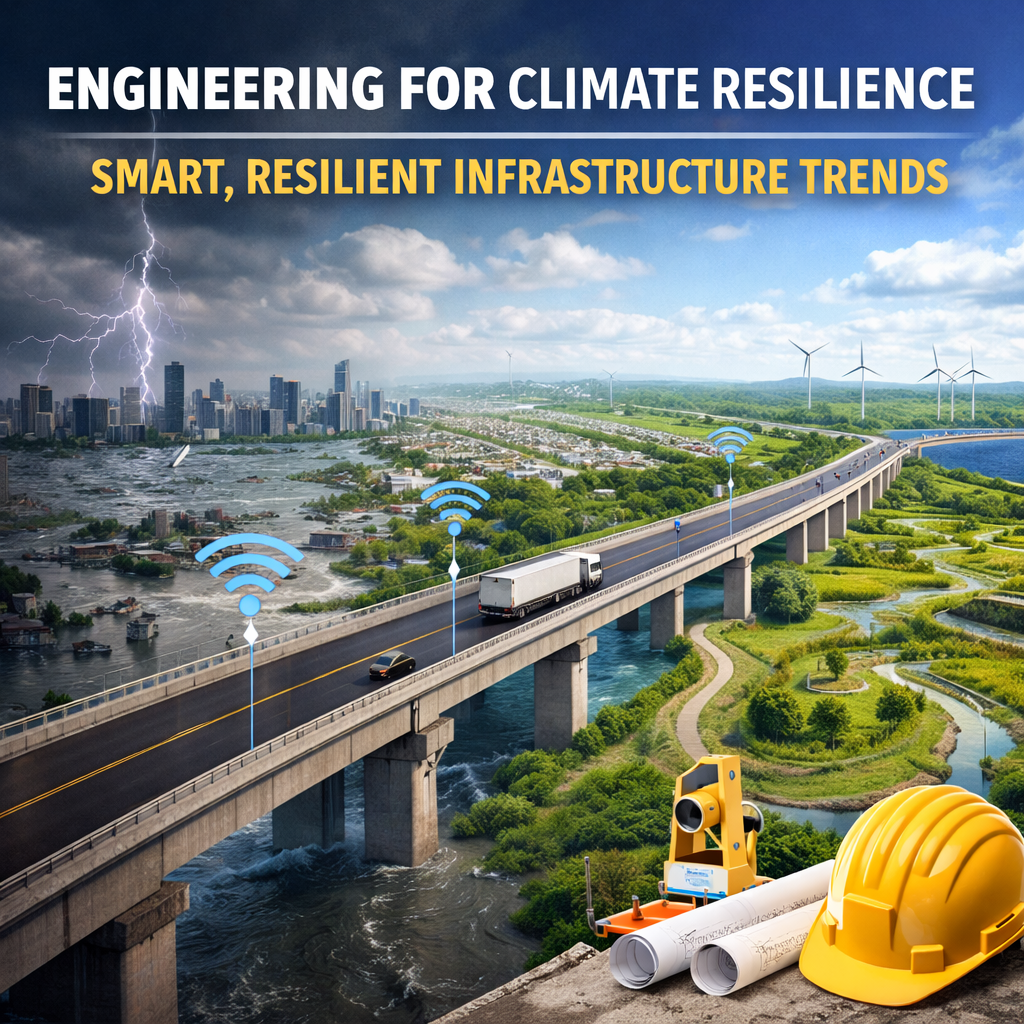
Climate change has become one of the most defining challenges of the 21st century, reshaping how societies plan, design, and maintain their infrastructure. Extreme weather events, rising temperatures, unpredictable rainfall, and sea-level rise are placing unprecedented stress on systems that were often designed for stable, historical conditions. Roads wash away under heavy floods, energy grids fail during heatwaves, and urban drainage systems collapse under intense rainfall. In response, the concept of engineering for climate resilience has moved from theory into urgent practice.
Resilient infrastructure focuses on the ability of systems to anticipate, absorb, adapt to, and recover from climate-related shocks while continuing to function effectively. This shift represents a fundamental evolution in engineering—one that prioritizes long-term performance, adaptability, and sustainability rather than short-term efficiency alone. Across the world, engineers are embracing smart technologies, innovative materials, and integrated planning approaches to future-proof infrastructure against a rapidly changing climate.
Designing for Future Climate Conditions
One of the most important developments in resilience engineering is the use of future climate data during the design phase. Instead of relying solely on historical weather patterns, engineers now incorporate climate models that project temperature changes, rainfall intensity, storm frequency, and sea-level rise over coming decades.
This approach ensures that infrastructure can withstand conditions that are more extreme than those experienced in the past. For example, bridges are designed with higher load tolerances, drainage systems are sized to manage intense rainfall events, and coastal structures are elevated to reduce flood risk. By accounting for future uncertainties at the outset, engineers significantly reduce the likelihood of premature failure and costly retrofits.
Smart Infrastructure and Digital Technologies
Digital innovation has become a cornerstone of climate-resilient engineering. Smart infrastructure uses sensors, data analytics, and automated systems to monitor performance in real time. Sensors embedded in bridges, roads, pipelines, and buildings collect continuous data on stress, vibration, moisture, and temperature.
This information allows engineers and operators to identify early signs of deterioration and intervene before damage escalates. Predictive maintenance not only improves safety but also reduces operational costs and downtime. In addition, digital twins—virtual models of physical assets—enable engineers to simulate extreme climate scenarios and test how infrastructure will respond, helping decision-makers identify vulnerabilities and strengthen designs proactively.
Advanced Materials for Harsh Environments
Material science is playing a critical role in improving infrastructure resilience. Traditional construction materials often degrade quickly when exposed to extreme heat, moisture, or chemical stress. In contrast, new materials are being developed specifically to perform under changing climate conditions.
Examples include self-healing concrete that repairs small cracks automatically, corrosion-resistant steel for coastal environments, and flexible composite materials that absorb seismic or wind-induced forces. These innovations extend the lifespan of infrastructure assets and improve their ability to recover after extreme events, reducing long-term maintenance demands and environmental impact.
Nature-Based and Green Engineering Solutions
An increasingly important trend in resilient infrastructure is the integration of nature-based solutions. These approaches work with natural systems rather than against them, blending engineering with ecology to create infrastructure that is both resilient and environmentally beneficial.
Green roofs, permeable pavements, urban wetlands, and restored floodplains help manage stormwater, reduce urban heat, and improve air and water quality. Unlike traditional hard infrastructure, these solutions often deliver multiple benefits simultaneously—flood control, biodiversity enhancement, and improved public spaces—while adapting naturally to changing climate conditions.
Resilient Urban Planning and Integrated Design
Climate resilience is not achieved through isolated projects; it requires coordinated urban planning and integrated design strategies. Cities around the world are embedding resilience into zoning regulations, building codes, and land-use policies to guide sustainable growth.
Integrated planning aligns transportation, housing, energy, and water systems with environmental goals. Measures such as green corridors, flood retention zones, and mixed-use development reduce climate risks while enhancing urban livability. By linking engineering decisions with social and environmental priorities, cities can create infrastructure networks that support both resilience and quality of life.
Protecting Critical Infrastructure Systems
Energy and transportation networks are among the most vulnerable systems in a changing climate. Disruptions to these services can have cascading effects on economies and public safety. Engineers are responding by redesigning critical infrastructure to be more flexible and decentralized.
In the energy sector, renewable power sources, microgrids, and battery storage systems improve reliability during extreme weather. Transportation infrastructure is being adapted with heat-resistant materials, improved drainage, and elevated alignments to reduce exposure to flooding and temperature extremes. These measures help ensure continuity of essential services during climate-related disruptions.
Economic Value of Resilient Infrastructure
While resilient infrastructure often requires higher upfront investment, it delivers substantial long-term economic benefits. Studies consistently show that investing in resilience reduces disaster recovery costs, limits economic losses, and protects public assets.
By preventing damage rather than reacting to it, governments and private developers can achieve better financial outcomes over the lifecycle of infrastructure projects. In rapidly growing urban areas, resilience-focused investments also enhance property values, investor confidence, and overall economic stability.
Community Engagement and Social Resilience
Engineering solutions alone cannot deliver true climate resilience without community involvement. Public awareness, stakeholder participation, and local capacity building are essential components of successful infrastructure projects.
Engaging communities helps engineers understand local risks, behaviors, and priorities, leading to more effective and socially acceptable solutions. Education and preparedness initiatives further strengthen resilience by enabling people to respond effectively when climate-related events occur. Infrastructure that supports social resilience is more likely to be maintained, respected, and used as intended.
Conclusion: Building Infrastructure for an Uncertain Future
As climate change accelerates, the need for smart, resilient infrastructure has never been greater. Engineering for climate resilience represents a shift toward long-term thinking—designing systems that can adapt, recover, and continue serving communities under uncertain conditions.
Through future-focused design, smart technologies, advanced materials, nature-based solutions, and integrated planning, engineers are redefining how infrastructure is built and maintained. These trends are not just technical innovations; they are essential strategies for safeguarding economies, protecting lives, and ensuring sustainable development.
Climate resilience is no longer a choice—it is a responsibility. The infrastructure built today will determine how well future generations can withstand the challenges of a changing world.