
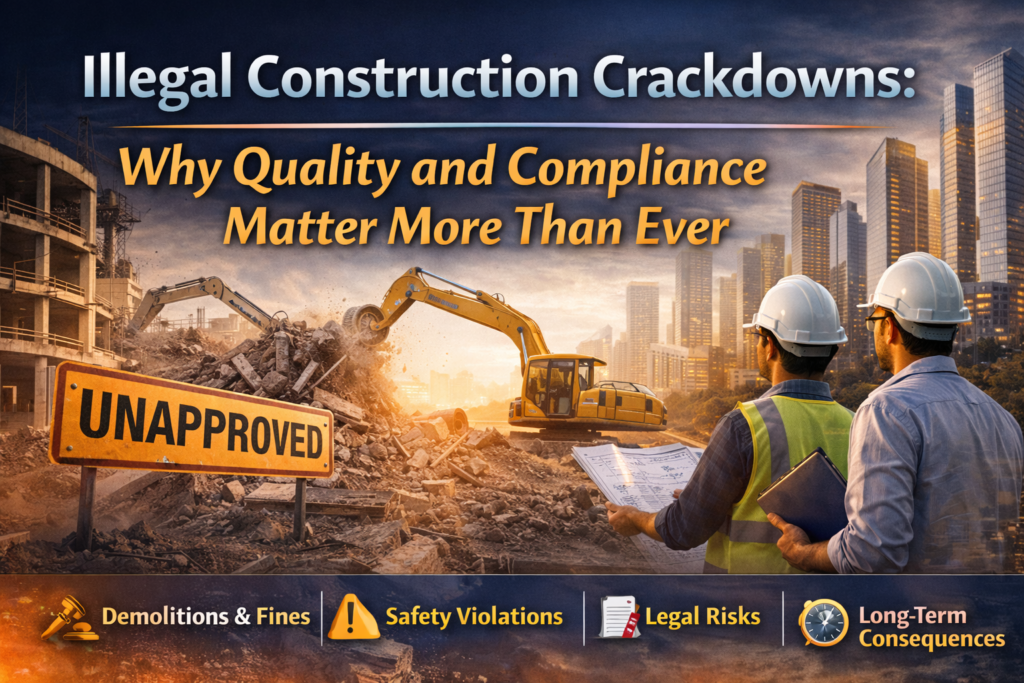
Across Pakistan, construction authorities are intensifying crackdowns on illegal and substandard construction. From Islamabad to Karachi and Rawalpindi, buildings without approvals, poor-quality structures, and safety violations are being sealed, fined, or demolished. These actions send a strong message to developers, investors, and homeowners alike: quality construction and regulatory compliance are no longer optional—they are essential.
For professional firms like Gemcon Engineering, this shift reinforces what has always been a core principle: building the right way, from day one.
The Rising Crackdown on Illegal Construction in Pakistan
Illegal construction has long been a challenge in Pakistan’s rapidly growing urban areas. Unauthorized housing schemes, unapproved building plans, and cost-cutting at the expense of safety have resulted in serious risks to life, property, and infrastructure.
In recent months, development authorities such as CDA, RDA, SBCA, and local municipal bodies have taken stricter actions, including:
- Demolition of unauthorized structures
- Sealing of non-compliant commercial buildings
- Heavy fines on developers violating approved plans
- Legal action against unsafe construction practices
These crackdowns are not just enforcement measures—they are a wake-up call for the entire construction industry.
Why Illegal Construction Happens
Illegal or non-compliant construction usually occurs due to:
- Skipping approvals to save time
- Using substandard materials to reduce costs
- Ignoring engineering drawings and safety standards
- Lack of professional site supervision
- Poor understanding of building regulations
While shortcuts may seem profitable initially, they almost always result in financial loss, legal trouble, and reputational damage in the long run.
The Real Cost of Non-Compliance
Many people underestimate the long-term cost of illegal construction. The consequences often include:
1. Legal and Financial Losses
Demolitions, penalties, and legal disputes can wipe out years of investment. In many cases, owners are forced to rebuild entirely—doubling their costs.
2. Safety Risks
Poor structural design and low-quality materials increase the risk of cracks, collapse, and accidents, especially in seismic zones.
3. Project Delays
Authorities can halt non-compliant projects at any stage, causing indefinite delays and loss of investor confidence.
4. Loss of Market Value
Properties built illegally have lower resale value and face difficulties in transfer, leasing, or financing.
Why Quality Construction Is the Only Sustainable Solution
Quality construction is not about luxury—it is about durability, safety, and long-term value. A professionally engineered building:
- Follows approved drawings and bylaws
- Uses tested and certified materials
- Meets structural and safety standards
- Performs better over time
- Protects both lives and investments
This is where companies like Gemcon Engineering make a critical difference.
Gemcon Engineering’s Commitment to Compliance and Quality
At Gemcon Engineering, quality and compliance are built into every stage of the project lifecycle. The company believes that true engineering excellence comes from doing things correctly, transparently, and professionally.
Key practices followed by Gemcon Engineering include:
- Strict adherence to local building bylaws and authority approvals
- Detailed engineering drawings and structural analysis
- High-standard material selection and quality checks
- Continuous site supervision and progress monitoring
- Transparent communication with clients and stakeholders
You can explore Gemcon’s professional construction and engineering services here:
Gemcon Engineering
Compliance Is Not a Barrier—It’s a Competitive Advantage
Some developers view regulations as obstacles. In reality, compliance offers major advantages:
- Faster approvals for future projects
- Higher client trust and credibility
- Stronger brand reputation
- Reduced legal risk
- Better long-term profitability
Professional engineering firms understand that compliance is not about restrictions—it’s about building smarter and safer.
The Role of Professional Engineering in Preventing Illegal Construction
Illegal construction thrives where professional oversight is missing. Qualified engineering teams play a vital role in ensuring:
- Accurate planning before construction begins
- Compliance with zoning and height regulations
- Structural safety through proper design
- Quality execution on-site
- Documentation for inspections and approvals
Gemcon Engineering’s experienced engineers and site teams ensure that every project aligns with both engineering standards and legal requirements.
Learning from Crackdowns: A Smarter Way Forward
The ongoing crackdowns should not be viewed negatively. Instead, they present an opportunity for the construction industry to reset and improve.
Developers and clients should now ask critical questions:
- Is my project fully approved?
- Are qualified engineers supervising construction?
- Are materials tested and verified?
- Is quality control being documented?
Choosing the right engineering partner can prevent costly mistakes before they happen.
Why Clients Trust Gemcon Engineering
Clients working with Gemcon Engineering benefit from:
- Peace of mind through legal compliance
- High construction standards
- Transparent project execution
- Reliable timelines and cost control
- Long-term structural performance
This trust is built through consistency, professionalism, and a commitment to doing what’s right—not what’s easiest.
Conclusion: Building Right Is the Only Way Forward
The era of unchecked and illegal construction in Pakistan is coming to an end. Authorities, clients, and communities are demanding safe, compliant, and high-quality construction.
For developers and property owners, the message is clear:
Cutting corners today leads to serious consequences tomorrow.
By choosing professional engineering firms like Gemcon Engineering, stakeholders ensure that their projects are not only legally approved but also structurally sound, safe, and future-ready.
Quality and compliance are no longer optional—they are the foundation of sustainable construction.