
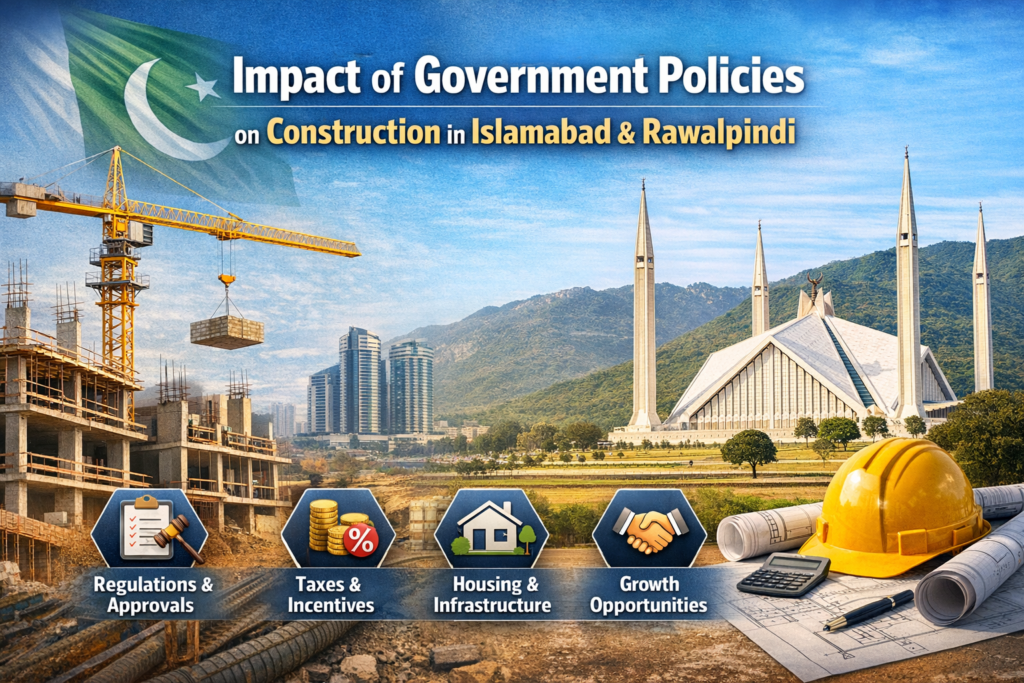
The construction industry in Islamabad and Rawalpindi plays a vital role in Pakistan’s economic growth. From residential housing projects to commercial plazas and infrastructure development, the sector contributes significantly to employment and investment. However, one of the most powerful forces shaping this industry is government policy.
Government regulations, taxation systems, urban planning strategies, and environmental laws directly affect how construction companies operate. For professional firms like Gemcon Engineering, understanding these policies is essential to deliver safe, compliant, and high-quality construction services.
In this article, we explore how government policies influence Islamabad and Rawalpindi’s construction industry and what it means for builders, developers, and investors.
1. Regulatory Authorities and Building Approvals
In Islamabad, the Capital Development Authority (CDA) regulates construction activities. In Rawalpindi, the Rawalpindi Development Authority (RDA) oversees building approvals and zoning regulations. These authorities control:
- Building plan approvals
- Zoning compliance
- Height restrictions
- Structural safety standards
- Land use regulations
Strict building codes ensure safety and quality. However, delays in approvals can impact project timelines. Construction companies must ensure proper documentation and compliance to avoid penalties or legal complications. Experienced firms like Gemcon Engineering help clients navigate approval procedures efficiently, reducing risks and saving time.
2. Tax Policies and Construction Costs
Taxation policies significantly impact the construction industry in Islamabad and Rawalpindi. Government decisions regarding:
- Sales tax on construction materials
- Capital gain tax on property
- Withholding tax
- Federal excise duties
directly influence project costs.
When taxes increase, construction materials such as cement, steel, and imported fixtures become expensive. This raises overall project budgets and can slow down investment in real estate.
On the other hand, tax relief packages and construction amnesty schemes introduced in recent years have boosted the sector. Such incentives encourage investors to initiate new projects and stimulate economic activity.
3. Housing Schemes and Development Policies
Government housing policies play a major role in shaping urban expansion. Initiatives aimed at affordable housing, low-cost housing schemes, and new sector developments increase demand for construction services.
Islamabad’s sector expansions and Rawalpindi’s new residential projects create opportunities for:
- Residential construction
- Commercial developments
- Infrastructure expansion
- Utility services
When the government launches housing support programs or mortgage financing facilities, it increases purchasing power for middle-income families. This directly increases demand for builders and contractors. Professional companies like Gemcon Engineering benefit from these opportunities by offering complete construction and design solutions.
4. Interest Rates and Financing Policies
State Bank policies regarding interest rates also influence construction activity. When interest rates are:
- Low: Developers and investors borrow more, boosting construction.
- High: Borrowing becomes expensive, slowing down projects.
Housing finance schemes introduced by the government encourage home ownership. This leads to increased residential construction in Islamabad and Rawalpindi.
Financing policies also affect commercial builders who rely on loans for large-scale projects. Stable economic policies create confidence in the real estate and construction markets.
5. Urban Planning and Smart City Initiatives
Islamabad is known for its planned sectors and organized layout. Government urban planning policies aim to:
- Improve road infrastructure
- Expand commercial zones
- Develop smart city solutions
- Promote mixed-use developments
Modern planning strategies encourage sustainable construction and green building practices. Developers now focus on energy-efficient buildings and better drainage systems to meet regulatory standards.
Companies that adapt to these modern standards stay competitive. Gemcon Engineering integrates smart planning and engineering precision to meet urban development requirements.
6. Environmental Regulations and Sustainability
Environmental policies are becoming stricter in both cities. Construction projects must comply with:
- Environmental Impact Assessments (EIA)
- Waste management regulations
- Water drainage and sewerage standards
- Green area preservation rules
These regulations increase initial compliance costs but ensure long-term sustainability. Islamabad, being the capital city, has stricter environmental monitoring. Builders must follow proper soil testing, structural checks, and eco-friendly construction practices.
Forward-thinking construction firms align their strategies with environmental policies to avoid project delays and penalties.
7. Public Infrastructure Development
Government-funded infrastructure projects significantly influence the private construction market. Examples include:
- Road networks
- Metro bus expansion
- Bridges and underpasses
- Public buildings and institutions
When the government invests in infrastructure, property values rise in surrounding areas. This encourages private developers to start new residential and commercial projects.
Infrastructure growth in Rawalpindi and Islamabad creates a ripple effect, benefiting contractors, architects, suppliers, and labor markets.
8. Challenges Caused by Policy Gaps
While government policies provide structure, certain challenges remain:
- Bureaucratic delays
- Frequent changes in tax policies
- Lack of policy consistency
- Complex approval procedures
Uncertainty in policies can reduce investor confidence. Developers prefer stable regulatory environments for long-term planning. Professional construction firms that stay updated with policy changes are better positioned to manage risks effectively.
9. Opportunities for Growth in the Construction Industry
Despite challenges, government policies also open doors for growth:
- Incentives for affordable housing
- Development of new residential sectors
- Smart city initiatives
- Public-private partnerships (PPP)
- Focus on sustainable development
Companies that maintain compliance, quality standards, and transparent operations benefit the most. Gemcon Engineering positions itself as a reliable construction partner by adhering to regulatory standards and delivering high-quality engineering solutions across Islamabad and Rawalpindi.
Conclusion
Government policies play a crucial role in shaping Islamabad and Rawalpindi’s construction industry. From building regulations and taxation to housing schemes and environmental standards, every decision affects developers, investors, and homeowners.
While policy changes can create challenges, they also generate opportunities for growth and innovation. Construction companies that understand regulatory frameworks and adapt to evolving government strategies remain successful in the long run.
For reliable, compliant, and professional construction services in Islamabad and Rawalpindi, visit Gemcon Engineering.