Introduction
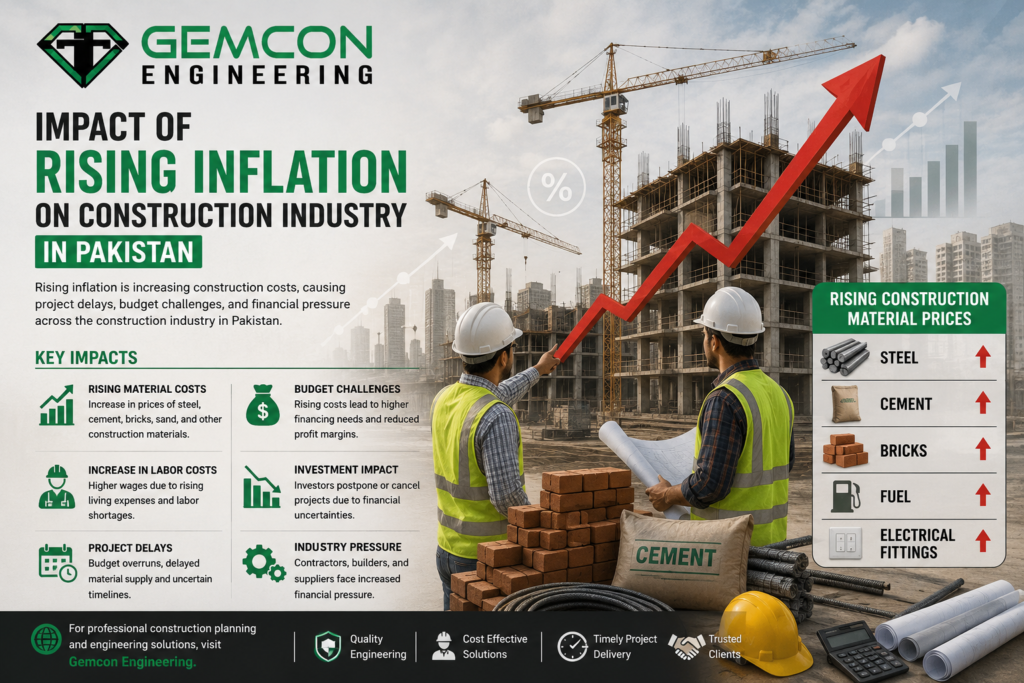
Pakistan’s construction industry plays a vital role in economic development by supporting infrastructure projects, housing schemes, commercial buildings, and employment generation. However, in recent years, rising inflation has created serious challenges for the sector.
Increasing prices of raw materials, fuel, transportation, and labor have significantly raised overall construction costs. As a result, contractors, investors, and homeowners are all facing financial pressure and uncertainty in project planning.
For professional construction planning and engineering solutions, visit Gemcon Engineering.
What Is Inflation?
Inflation refers to the continuous rise in the prices of goods and services over time. In Pakistan, inflation has impacted nearly every industry, but construction is among the most affected sectors.
Construction projects depend heavily on materials such as cement, steel, bricks, sand, electrical fittings, and fuel. When prices of these inputs increase, the total project cost rises directly.
Key reasons behind inflation in Pakistan include:
- Depreciation of the Pakistani rupee
- Increased import costs
- Global supply chain disruptions
- Higher fuel and energy prices
Rising Construction Material Costs
One of the most significant impacts of inflation is the sharp increase in construction material prices.
Steel Prices
Steel is essential for structural strength in buildings, bridges, and infrastructure projects. Due to inflation and global market fluctuations, steel prices in Pakistan have increased significantly, directly raising construction budgets.
Cement Prices
Cement is used in almost every stage of construction. Rising fuel and transportation costs have pushed cement prices upward, affecting both small and large-scale projects.
Imported Construction Materials
Modern construction often requires imported materials such as:
- Elevators
- Machinery
- Tiles and fittings
- Electrical systems
Currency depreciation and import taxes have made these items significantly more expensive.
Increase in Labor Costs
Inflation has also impacted labor wages across Pakistan. Skilled workers such as masons, electricians, plumbers, and painters now demand higher salaries due to rising living expenses.
This leads to:
- Higher project costs
- Skilled labor shortages
- Increased competition for workers
- Delays in project completion
In some cases, labor moves to overseas markets, further increasing shortages in the local industry.
Project Delays and Budget Challenges
Rising inflation creates uncertainty in cost estimation and project planning. Many construction projects face delays due to budget constraints.
Common challenges include:
- Budget overruns
- Delayed material supply
- Increased financing costs
- Reduced profit margins
- Uncertain project timelines
As a result, some investors postpone or cancel projects due to financial risks.
Impact on the Real Estate Sector
The construction and real estate sectors are closely connected. When construction costs rise, property prices also increase.
This leads to:
- Reduced affordability for middle-income families
- Higher property investment costs
- Changes in rental market trends
- Slower housing demand growth
Despite these challenges, demand for housing and commercial infrastructure remains strong in major cities.
Challenges for Small Builders and Contractors
Large construction companies may absorb inflation better due to stronger financial resources. However, small builders and contractors face serious difficulties.
They struggle with:
- Limited purchasing power for bulk materials
- Cash flow management issues
- Delayed payments from clients
- Maintaining project quality under budget pressure
This creates intense competition and financial instability in the sector.
How Construction Companies Are Adapting
To survive rising inflation, many construction firms in Pakistan are adopting smarter strategies.
Better Project Planning
Accurate cost estimation and planning help reduce financial risks and unexpected expenses.
Use of Modern Technology
Advanced machinery and construction software improve efficiency and reduce material waste.
Sustainable Construction Practices
Energy-efficient designs and durable materials reduce long-term maintenance costs.
Bulk Purchasing Strategies
Some companies purchase materials in advance to avoid future price hikes.
Professional firms like Gemcon Engineering help clients manage construction challenges through engineering expertise and cost-effective planning.
Government’s Role in Stabilizing the Industry
The government plays an important role in reducing inflationary pressure on construction.
Key measures include:
- Tax relief on construction materials
- Stable interest rates
- Improved import regulations
- Housing development incentives
- Infrastructure investment projects
Such policies can improve investor confidence and support long-term economic stability.
Future of the Construction Industry in Pakistan
Despite inflationary challenges, Pakistan’s construction industry still holds strong growth potential. Factors such as population growth, urbanization, and housing demand continue to drive development.
The future success of the industry depends on:
- Smart financial planning
- Efficient resource management
- Adoption of modern construction technologies
- Collaboration with experienced engineering firms
Companies that adapt to economic changes will remain competitive in the long run.
Conclusion
Rising inflation has significantly impacted Pakistan’s construction industry by increasing material costs, labor wages, and overall project expenses. This has created financial pressure for builders, investors, and homeowners.
However, with proper planning, modern construction techniques, and expert engineering support, projects can still be completed successfully and efficiently.
For reliable construction, engineering design, and project management services in Pakistan, visit Gemcon Engineering.