
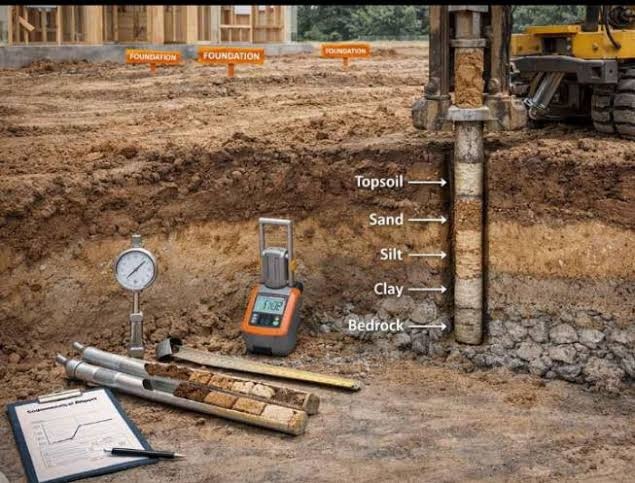
Every homeowner dreams of a strong, beautiful house. Most of the budget goes into design, materials, and finishing, yet the most important part of any building is the one nobody sees: the ground beneath it. Many plot owners skip soil testing to save a little money and time. In reality, this shortcut is one of the costliest mistakes in construction.
In this guide, we compare building with and without a geotechnical report and explain why soil testing in Islamabad should be your first step before breaking ground.
What Is a Geotechnical Report?
A geotechnical report is a document prepared after engineers study the soil on your plot. They collect samples from different depths, test them in a laboratory, and analyze how the soil will behave under the weight of your building.
The report typically tells you:
- The type of soil on your plot (clay, silt, sand, gravel, or rock)
- The bearing capacity, meaning how much load the soil can safely carry
- The depth of the groundwater table
- Whether the soil is likely to swell, shrink, or settle
- The recommended foundation type and depth
Professional soil testing services give structural engineers the data they need to design a foundation that matches your plot, rather than relying on guesswork or a generic design.
Why Islamabad Plots Need Special Attention
Islamabad and the surrounding region have varied ground conditions. One sector may have firm, compact soil, while a plot in another area may have clayey layers, loose fill, or sloping terrain. Even plots in the same neighborhood can differ.
The region also lies in a seismically active zone, so a foundation must be designed with care. Soil conditions directly affect how a building responds to ground movement, heavy rain, and long-term loading. A design that works perfectly on one plot may fail on another.
The Hidden Risks of Building Without Soil Testing
1. Foundation Settlement
If the soil cannot carry the load of the building, it compresses unevenly over time. This is called differential settlement, and it is one of the most common causes of structural damage. One corner of the house may sink slightly more than another, putting stress on beams, columns, and walls.
2. Cracks in Walls, Floors, and Ceilings
Hairline cracks are not always cosmetic. Cracks that run diagonally across walls, appear above doors and windows, or keep widening are often signs of foundation movement. Fixing them after the house is finished means repeated repairs, repainting, and disruption to your family.
3. Expansive Clay Problems
Some clay soils swell when they absorb water and shrink when they dry. This constant movement pushes and pulls on the foundation. Without a soil report, you will not know if your plot has this type of soil until damage appears.
4. Water Table Surprises
If groundwater sits close to the surface, it can cause dampness, seepage in basements, and corrosion of reinforcement steel. A soil investigation identifies the water level so your engineer can plan waterproofing and drainage properly.
5. Over-Designed or Under-Designed Foundations
Without data, contractors tend to play it safe by overbuilding, which wastes cement and steel, or they follow a standard design that may be too weak for your soil. Both outcomes cost you money. Accurate soil data lets engineers design a foundation that is safe and economical.
6. Safety Risks for Your Family
In the worst cases, structural failure puts lives at risk. A building is meant to last decades, and your family’s safety should never depend on assumptions about the soil.
7. Trouble with Approvals and Resale
Many authorities and professional consultants expect proper geotechnical data for larger or multi-story projects. A house with a documented, engineered foundation also gives buyers more confidence when you sell.
Soil Testing vs. Skipping It: A Quick Comparison
| Factor | With Soil Testing | Without Soil Testing |
|---|---|---|
| Foundation design | Based on real data | Based on assumptions |
| Risk of cracks and settlement | Much lower | Significantly higher |
| Construction cost | Optimized | Often wasted or underbudgeted |
| Long-term maintenance | Minimal | Frequent and expensive |
| Safety | Engineered and reliable | Uncertain |
| Peace of mind | High | Low |
The Real Cost of Skipping the Test
Soil testing usually costs only a small fraction of the total construction budget. Repairing a failed foundation, on the other hand, can cost many times more, and in severe cases it may mean demolishing and rebuilding part of the structure. Skipping the test saves a small amount today and can cost you a fortune later.
Think of it as insurance. You pay a modest amount once, and in return you avoid the risk of major structural problems for the life of your building.
How the Soil Testing Process Works
- Site visit and planning: Engineers inspect your plot and decide how many test points are needed and at what depths.
- Drilling and sampling: Boreholes or trial pits are made to collect soil samples and record the layers underground.
- Field tests: Tests such as the Standard Penetration Test (SPT) measure how resistant the soil is at different depths.
- Laboratory analysis: Samples are tested to determine properties such as grain size, moisture content, plasticity, and strength.
- Report preparation: Findings are compiled into a geotechnical report with clear recommendations for foundation type, depth, and safe bearing capacity.
- Design coordination: Your architect and structural engineer use the report to finalize a safe design.
The entire process is usually quick compared with the months of construction that follow, so it will not delay your project in any meaningful way.
When Is Soil Testing Absolutely Necessary?
You should always test the soil if you are:
- Building a multi-story house or commercial building
- Constructing on sloped, filled, or previously unbuilt land
- Planning a basement
- Building near a nullah, stream, or area with a high water table
- Working with a plot where nearby buildings show cracks or settlement
Even for a small single-story home, a test is a wise investment.
Tips for Choosing a Soil Testing Provider
- Choose a company with qualified geotechnical and structural engineers
- Make sure they use proper field equipment and certified laboratory testing
- Ask for a detailed written report, not just verbal advice
- Check that the report includes foundation recommendations
- Look for a firm that can also support you with construction and structural design
Final Thoughts
A house is only as strong as the ground it stands on. Skipping a geotechnical report may look like a harmless way to cut costs, but it exposes your investment to settlement, cracking, water damage, and safety risks that are expensive and difficult to fix later.
If you are planning to build, make soil testing in Islamabad the very first step of your project. With accurate data in hand, your architect, engineer, and contractor can build with confidence, and you can enjoy a home that stays strong for generations.
Ready to start? Learn more about professional soil testing services and get your plot tested before construction begins.