
Every safe and cost-effective foundation begins with one thing: reliable knowledge of the ground beneath it. Before a single column or footing is designed, geotechnical engineers must understand how the soil will behave under load, how deep stable strata lie, and what risks — settlement, liquefaction, or bearing failure — the site may pose.
Two of the most widely used methods to gather this information are Plate Load Tests (PLT) and Borehole Investigations. While both aim to characterize subsurface conditions, they differ significantly in approach, depth of insight, cost, and application. Choosing the right method — or combination of methods — can make the difference between an efficient, durable foundation and one prone to costly failures.
In this blog, we break down how each method works, their respective advantages and limitations, and how firms like Gemcon Engineering help project teams decide which approach — or combination — fits their site conditions best.
What Is a Plate Load Test?
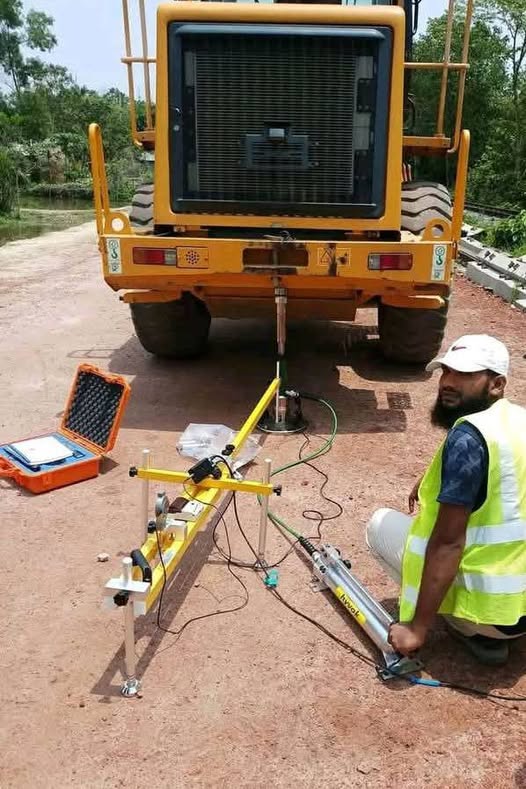
A Plate Load Test is an in-situ (on-site) test used to determine the bearing capacity and settlement characteristics of soil at or near the proposed foundation level. A rigid steel plate — typically circular or square — is placed on a prepared soil surface, and a gradually increasing load is applied, often using a hydraulic jack reacting against a loaded platform or anchored frame. Settlement is measured at each load increment until failure or a target deformation is reached.
Key outputs of a PLT include:
- Safe bearing capacity of the soil
- Load-settlement behavior
- Modulus of subgrade reaction (useful for pavement and raft foundation design)
Advantages:
- Provides direct, real-time data on soil behavior under load
- Useful for shallow foundations, pavements, and industrial floor slabs
- Simulates actual loading conditions more realistically than lab tests
Limitations:
- Tests only a shallow zone of influence (roughly 1.5–2 times the plate width), which may not represent deeper soil layers
- Time-consuming and labor-intensive for large sites
- Results can be affected by the size of the plate relative to the actual foundation (scale effect)
What Is a Borehole Investigation?
A Borehole Investigation involves drilling into the ground to collect soil and rock samples at various depths, allowing engineers to develop a detailed subsurface profile. Standard Penetration Tests (SPT), undisturbed sampling, and laboratory testing (for shear strength, consolidation, grain size, etc.) are typically conducted alongside drilling.
Key outputs of a borehole investigation include:
- Soil stratification and classification
- Groundwater table depth
- SPT N-values for estimating strength and density
- Detailed geotechnical parameters for deep and shallow foundation design
Advantages:
- Provides information on deeper soil layers, critical for pile foundations and multi-story structures
- Identifies groundwater conditions, which significantly influence foundation design and construction methods
- Enables comprehensive laboratory testing for a wide range of soil parameters
Limitations:
- More expensive and time-intensive than surface-level testing
- Point-specific data; multiple boreholes are needed to capture soil variability across a site
- Requires skilled interpretation to translate lab results into design parameters
Plate Load Test vs. Borehole Investigation: A Side-by-Side Comparison
| Aspect | Plate Load Test | Borehole Investigation |
|---|---|---|
| Depth of Investigation | Shallow (near surface) | Shallow to deep |
| Best Suited For | Shallow foundations, pavements, floor slabs | Deep foundations, high-rise structures |
| Data Type | Direct load-settlement behavior | Stratigraphy, strength, groundwater, lab parameters |
| Cost & Time | Moderate, faster for small sites | Higher, especially for deep or multiple boreholes |
| Groundwater Information | Not typically obtained | Directly measured |
| Representativeness | Limited to zone of influence | Can represent large depth and multiple layers |
Which Method Should You Choose?
The choice between a plate load test and a borehole investigation isn’t always an either-or decision — in many projects, the two methods complement each other. Borehole investigations establish the broader subsurface profile and identify potential problem layers, while plate load tests validate actual bearing capacity and settlement behavior at critical locations, particularly for shallow foundations or pavement design.
For light structures, warehouses, or pavement projects on relatively uniform, shallow soil, a plate load test alone may suffice. For medium to high-rise buildings, bridges, or sites with variable or deep soil strata, a thorough borehole investigation — often supplemented with plate load testing — is essential to ensure a safe and economical foundation design.
Final Thoughts
Both plate load tests and borehole investigations play vital, complementary roles in geotechnical engineering. Understanding their strengths and limitations allows engineers and developers to select the right combination of methods for their specific site conditions, structural loads, and budget constraints.
Partnering with an experienced geotechnical engineering team ensures these investigations are planned, executed, and interpreted correctly — reducing risk and setting the foundation for a structurally sound project. To learn more about professional geotechnical investigation and foundation design services, visit Gemcon Engineering.