
Every building, from a two-story house to a multi-story plaza, ends up resting on soil. If the soil cannot carry the load safely, the structure can settle unevenly, crack, or in the worst case fail. That is why engineers ask one question before designing any foundation: how much load can this soil safely carry?
The answer is the safe bearing capacity (SBC) of the soil. This guide explains what it means, how it is tested in Pakistan, and how to use the results.
What Is Safe Bearing Capacity?
Soil has a limit to the pressure it can take before it fails. This limit is called the ultimate bearing capacity. Because you never want to design right at the edge of failure, engineers divide it by a factor of safety (commonly around 2.5 to 3) to get the safe bearing capacity.
In simple terms:
Safe Bearing Capacity = Ultimate Bearing Capacity ÷ Factor of Safety
SBC is usually expressed in kN/m², tons per square foot (TSF), or kips per square foot (KSF). Pakistani practice commonly uses TSF and kN/m² in reports.
A related term is allowable bearing pressure, which also considers how much settlement the structure can tolerate. A soil may not fail, yet still settle too much, so both strength and settlement are checked.
Why SBC Testing Matters
Skipping soil investigation to save money is one of the most expensive mistakes in construction. Testing helps you:
- Choose the right foundation type, such as isolated footings, strip footings, raft, or piles
- Avoid differential settlement, which causes cracks in walls and floors
- Optimize design, so you do not over-design (wasting steel and concrete) or under-design (risking safety)
- Identify problem soils, such as soft clay, loose sand, expansive soil, or fill material
- Meet approval requirements, since many authorities and consultants require a geotechnical report for larger projects
Soil Conditions Across Pakistan
Soil varies widely across the country, which is why one site’s report cannot be used for another.
- Lahore and Punjab plains: mostly alluvial soils such as silts, clays, and sands, with water table depth that can vary.
- Karachi: coastal conditions, with sandy and silty soils, and in some areas a high water table and salinity concerns.
- Islamabad, Rawalpindi, and Potohar region: a mix of clay, silt, and weathered rock, sometimes with variable depth to firm layers.
- Murree and hill areas: sloping terrain, where slope stability matters as much as bearing capacity.
- Peshawar and KPK valleys: alluvial deposits that vary from site to site.
Even within the same city, soil can change from one plot to the next, so always test the actual site.
How Is SBC Tested in Pakistan?
SBC is not measured with a single test. It is determined through a combination of field investigation and laboratory testing, then calculated by a geotechnical engineer.
1. Site Investigation and Boreholes
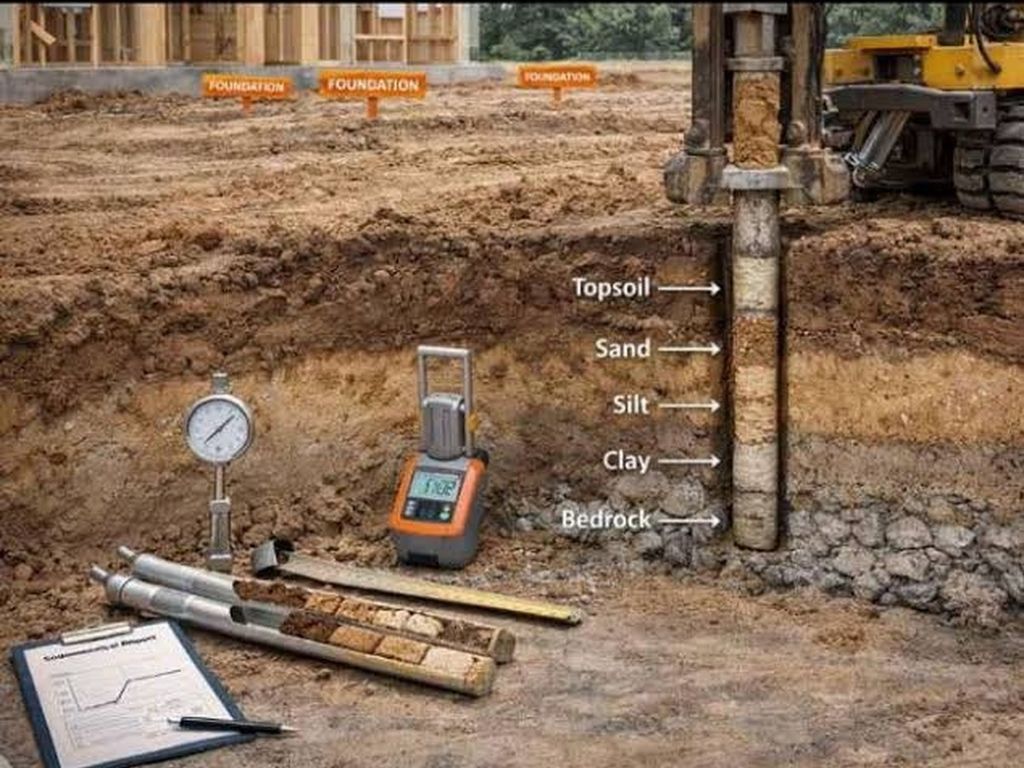
The process starts with drilling boreholes at selected locations on the plot. The number and depth depend on the building size, expected loads, and site conditions. Soil samples are collected at different depths, and the soil layers and groundwater level are recorded in a borehole log.
2. Standard Penetration Test (SPT)
The SPT is the most widely used field test in Pakistan. A split-spoon sampler is driven into the soil at the bottom of a borehole using a standard hammer, and the number of blows needed to drive it 300 mm (the N-value) is recorded.
- Low N-values indicate loose or soft soil.
- High N-values indicate dense or stiff soil.
Engineers use N-values with established correlations to estimate strength and bearing capacity, and the test also gives disturbed samples for laboratory work. It is commonly carried out following ASTM D1586.
3. Plate Load Test
In a plate load test, a steel plate is placed at foundation level and loaded in stages using a hydraulic jack against a reaction frame. Settlement is measured at each load increment, and a load-settlement curve is drawn.
This test gives a direct indication of how the soil behaves under load, which makes it useful for important structures or where correlations are uncertain. Its limitation is that the plate is small compared with a real foundation, so its results reflect only a shallow depth of soil and need proper interpretation.
4. Laboratory Tests on Soil Samples
Samples from the boreholes go to a laboratory for tests that include:
- Moisture content and bulk density: basic soil condition
- Sieve analysis and hydrometer test: grain size distribution
- Atterberg limits: plasticity of clays and silts
- Specific gravity: needed for several calculations
- Direct shear or triaxial test: soil strength parameters (cohesion and angle of internal friction)
- Consolidation test: how much and how fast clay soils will settle
5. Chemical Tests
In areas with salinity or aggressive groundwater, tests for sulfates and chlorides help decide what type of cement and protection the foundation needs.
6. Other Field Tests
Depending on the project, engineers may also use the core cutter or sand replacement methods to check field density, or cone penetration tests in suitable soils.
From Test Results to SBC
Once the data is collected, the geotechnical engineer:
- Classifies the soil layers
- Calculates ultimate bearing capacity using established theories, such as Terzaghi’s equation or other methods
- Applies the factor of safety
- Checks expected settlement
- Recommends a foundation type, depth, and allowable bearing pressure
The final geotechnical report includes borehole logs, test results, groundwater information, SBC values at different depths, and foundation recommendations.
Typical Range: A Rough Guide Only
As a very rough idea, soft clays and loose sands have low bearing capacity, while dense gravels and rock have much higher capacity. Some people use general chart values for small projects, but these charts are only approximate and should never replace a site-specific test, especially where soil is variable, the water table is high, or the building is multi-story.
Common Mistakes to Avoid
- Using SBC values from a neighboring plot
- Testing at the wrong depth or too few locations
- Ignoring the water table
- Skipping testing on small projects
- Treating charts or “thumb rules” as a substitute for a report
- Not reading the recommendations about foundation depth and type
Choosing a Soil Testing Provider
Look for a provider with proper equipment, qualified geotechnical engineers, clear reporting, and experience with Pakistani soil conditions. Ask what tests are included, how many boreholes are recommended, and when you can expect the report. A well-prepared report should be easy to follow and give clear design recommendations.
If you need reliable testing and reporting, you can explore soil testing services from Gemcon Engineering to understand what a complete investigation covers.
Final Thoughts
Safe bearing capacity is the foundation of foundation design. Testing it properly protects your investment, avoids costly repairs, and helps your engineer design a safe and economical structure. Since soil changes from site to site, the best approach is simple: test your own soil, read the report, and design accordingly.
Planning a new building? Get your soil tested first. Visit Gemcon Engineering’s soil testing services to learn more.
FAQs
What is safe bearing capacity of soil?
It is the maximum pressure the soil can carry safely, after applying a factor of safety to the ultimate bearing capacity.
Which test is most common for SBC in Pakistan?
The Standard Penetration Test (SPT), usually combined with laboratory testing on soil samples.
Is a soil test necessary for a small house?
It is strongly recommended. Soil conditions vary, and a small test costs far less than foundation repairs.
How deep should boreholes be?
Depth depends on the building size, loads, and soil conditions, and is decided by the geotechnical engineer.
Can I use SBC values from a neighboring plot?
No. Soil can change even within short distances, so each site should be tested.