
Building a house is one of the biggest investments most Pakistani families make. Yet many homeowners focus on bricks, tiles and paint while paying little attention to the material that holds everything together: concrete. Choosing the wrong concrete grade can lead to cracks, weak slabs and expensive repairs later.
In this guide, we explain what concrete grades mean and how M15, M20 and M25 differ. We also cover which one suits each part of your home.
What Does Concrete Grade Mean?
A concrete grade shows the compressive strength of concrete after 28 days of curing. The letter “M” stands for “Mix,” and the number is the strength in megapascals (MPa).
- M15 means 15 MPa (about 2,200 psi)
- M20 means 20 MPa (about 2,900 psi)
- M25 means 25 MPa (about 3,600 psi)
In Pakistan, contractors often talk in psi, such as “3000 psi concrete” or “4000 psi concrete.” The M-grade system is the international standard, and understanding both helps you communicate clearly with your builder and engineer.
M15 Concrete: The Basic Grade
Typical mix ratio: 1:2:4 (cement : sand : aggregate)
M15 is a general-purpose, lower-strength concrete. It has enough strength for work that does not carry heavy structural loads.
Best uses in Pakistani homes:
- Plain cement concrete (PCC) under foundations
- Levelling courses and leaning concrete
- Flooring base in ground-floor rooms
- Boundary wall bases and footpaths
- Filling and backfilling work
Limitations: M15 should not be used for reinforced concrete columns, beams or roof slabs. It lacks the strength to carry structural loads safely, especially in a country where heavy monsoon rain and seismic activity put extra stress on buildings.
M20 Concrete: The Standard for Residential Construction
Typical mix ratio: 1:1.5:3
M20 is the most commonly used grade for residential buildings, and it is often the minimum recommended for reinforced concrete (RCC) work. It gives a good balance between strength, cost and workability.
Best uses in Pakistani homes:
- Roof slabs
- Beams and lintels
- Columns for single and double-storey houses
- Staircases and sunshades
- Raft and strip foundations in normal soil
For a typical 5 to 10 marla home in cities like Rawalpindi, Islamabad, Lahore or Karachi, M20 is usually the practical choice for the main structure. It performs well when the mix is proportioned correctly, the materials are good and the curing is done properly.
M25 Concrete: For Higher Strength and Durability
Typical mix ratio: 1:1:2
M25 is a stronger, denser concrete that suits structures with heavier loads or tougher exposure conditions. It costs more because it needs more cement, but the extra strength is worth it in the right situations.
Best uses in Pakistani homes:
- Columns and beams in three-storey or taller buildings
- Basement walls and retaining walls
- Structures in areas with high groundwater or coastal humidity
- Houses in seismic zones, such as parts of Khyber Pakhtunkhwa, Kashmir and Balochistan
- Long-span slabs and cantilevers
M25 also resists cracking and water penetration better, which matters for basements, water tanks and rooftops exposed to harsh summers and heavy rain.
Quick Comparison: M15 vs M20 vs M25
| Feature | M15 | M20 | M25 |
|---|---|---|---|
| Strength (28 days) | 15 MPa | 20 MPa | 25 MPa |
| Mix ratio | 1:2:4 | 1:1.5:3 | 1:1:2 |
| Main use | PCC, levelling | Standard RCC | Heavy or high-rise RCC |
| Cost | Lowest | Moderate | Higher |
| Structural use | No | Yes | Yes |
Factors That Affect Concrete Quality
Choosing the right grade is only half the job. Even M25 concrete can fail if it is poorly made. Keep these points in mind:
1. Quality of materials. Use fresh, branded cement, clean sand and properly graded crush. Sand with too much clay or silt weakens the mix.
2. Water-cement ratio. Adding extra water makes concrete easier to pour but significantly reduces its strength. Labourers often add water on site for convenience, so supervision is important.
3. Proper mixing. Machine mixing gives far more consistent results than hand mixing. Ready-mix concrete is also a good option for larger projects.
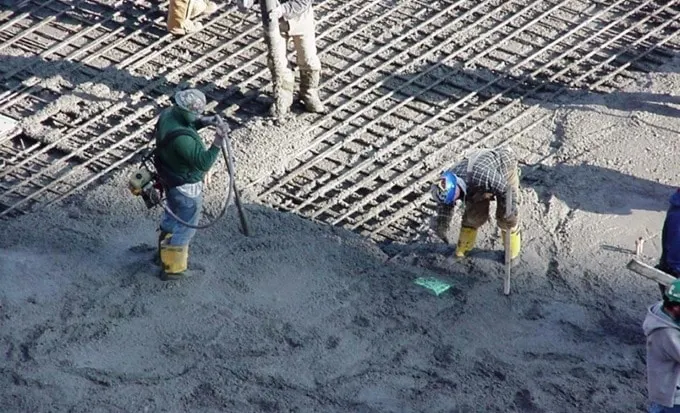
4. Compaction. Concrete must be vibrated properly to remove air pockets. Honeycombing, which appears as holes on the surface, is a sign of poor compaction.
5. Curing. Keep concrete moist for at least 7 days, and ideally 14 days in Pakistan’s hot weather. Skipping curing is one of the most common mistakes and can cut final strength by a large margin.
Common Mistakes Pakistani Homeowners Make
- Using M15 or a “guess mix” for slabs and columns to save money
- Ignoring soil testing before choosing foundation concrete
- Not testing concrete cubes on bigger projects
- Allowing too much water in the mix
- Removing formwork too early
Avoiding these mistakes costs far less than repairing a damaged structure later.
How to Choose the Right Grade for Your Home
There is no single answer for every house. The right grade depends on:
- Number of storeys
- Soil condition and groundwater level
- Seismic zone
- Span of slabs and beams
- Budget and long-term plans, such as adding another floor later
As a general guide, use M15 for non-structural base work, M20 for most standard residential RCC, and M25 for multi-storey, high-load or high-exposure conditions. Always have a qualified structural engineer approve the design, because small savings on concrete can lead to big losses later.
Final Thoughts
Understanding concrete grades helps you make smarter decisions, ask better questions and avoid being overcharged or under-served by contractors. M15, M20 and M25 each have a clear role in a well-built home, and using the right one in the right place gives you safety, durability and value for money.
If you are planning to build, renovate or extend your home, working with experienced professionals makes all the difference. Explore the construction services offered by Gemcon Engineering to see how an expert team can help you build a strong, long-lasting home from the foundation up.